






 France
 Espagnol
Visit Hoa Lu ancient capital of Vietnam
Hoa Lu was the first centralized feudal state of Vietnam which was set up to the capital under Dinh, early Le and Ly dynasties. Hoa Lu ancient capital has many important historical architectures with traditional festivals making people curious about.
Where is Hoa Lu and how to get there?
Hoa Lu is located about 100km from Hanoi, 12km from Ninh Binh’s city center and 10km from Tam Coc and surrounded by Truong An karst mountain and rice fields. A tour to Hoa Lu citadel is inseparable part of tour to Ninh Binh – “Halong Bay on land” from Hanoi. It is easy to reach Hoa Lu by cycling or motorbike from city center or Tam Coc. Regarding accommodation or tour service, you can get all from a travel agency in Hanoi.
There are some options for your travel to Ninh Binh from Hanoi:
By bus: this is a cheap option and often chosen by many travelers, especially it is just around 2 hours driving. Get on bus from Giap Bat bus station on Giai Phong Road.
By train: this option might be convenient for those who stay at central area in Hanoi such as Hoan Kiem, Ba Dinh, but it often takes longer with some stops on the way and there are fewer time options. Get on train SE7, SE9, SE19 at Hanoi railway station on Le Duan street.
What is the best time to visit Hoa Lu ancient capital?
You can visit Hoa Lu any time because the landscape is very beautiful and peaceful like paintings. However, there are some best periods that you should visit this area:
In the spring (from February to April): you should visit Hoa Lu ancient combined with tour to other places in Ninh Binh such as, Tam Coc, Trang An, Bich Dong pagoda…Because, it is not too cold and in particular, this time is Vietnamese New Year (Tet), you may see traditional festivals from pagodas that offer you interesting experiences and knowledge about the destination such as, Bai Dinh Pagoda…
In the early summer (May): this period is also the great time to visit Hoa Lu because it is the harvesting season that the whole area is beautified by yellow rice fields and that you can involve in the daily life of the local.
In general, February to May is considered as the best time to visit Hoa Lu ancient capital when you can both enjoy wonderful landscape and experience traditional festivals.
History of Hoa Lu ancient capital, Vietnam
From 968 to 1010, Hoa Lu was the capital of three dynasties including Dinh, early Le and Ly. In the short time, it witnessed many historical events that formed a free country after the “anarchy of 12 warlords” event, war against Tong dynasty (from China) and especially the foundation of Thang Long citadel (currently known as Hanoi).
Going back in history, after a long domination of Chinese, King Ngo Quyen defeated Nam Han with the victory of Bach Dang river and set up the capital in Co Loa, Hanoi. In 963, after the death of Ngo Quyen, the country was in the anarchy of 12 warlords. However, Dinh Bo Linh who was the man of victories put down the rebellion and reunified the nation under his rule. In 968, Dinh Bo Linh proclaimed himself emperor under the name Dinh Tien Hoang and founded Dai Co Viet set up the capital in Hoa Lu because he recognized Hoa Lu was a perfect area to protect a newly established state. After his death in 979 and the assassination of his oldest son, general Le Hoan who was the right hand of King Dinh in all battles became king opening up a new dynasty – early Le. King Le Hoan still remained capital in Hoa Lu until 1009 Ly Cong Uan took over the throne under the name of Ly Thai To and moved the capital to Thang Long (Hanoi) in 1010. King Ly Thai To later built a temple in Hoa Lu to dedicate 2 national heroes: Dinh Tien Hoang and Le Hoan. However, over the time the temple was destroyed so the locals rebuilt two separate temples, one for King Dinh and another for King Le.
Hoa Lu’s architecture
Because Hoa Lu owned a perfect location which is covered by a large naturally fence from karst mountain ranges along with Hoang Long river and enormous fields creating an undefeatable ditch system.
There were 3 layers in Hoa Lu: inner, outer and Southern citadels (in the population of Trang An eco-tourism complex). The outer citadel was situated outside Phi Van mountain range. This was the center of ancient capital where the palaces under king Dinh and king Le were built. There are now temples of king Dinh and king Le. Meanwhile, the inner citadel was located inside Phi Van where were the place of living of kings. There are now 30 antique items, relics kept at the museum next to the kinh Le’s temple. The most important and most visited places are 2 temples of king Dinh and king Le which were rebuilt on 17th century.
Visit Hoa Lu ancient capital and its nearby
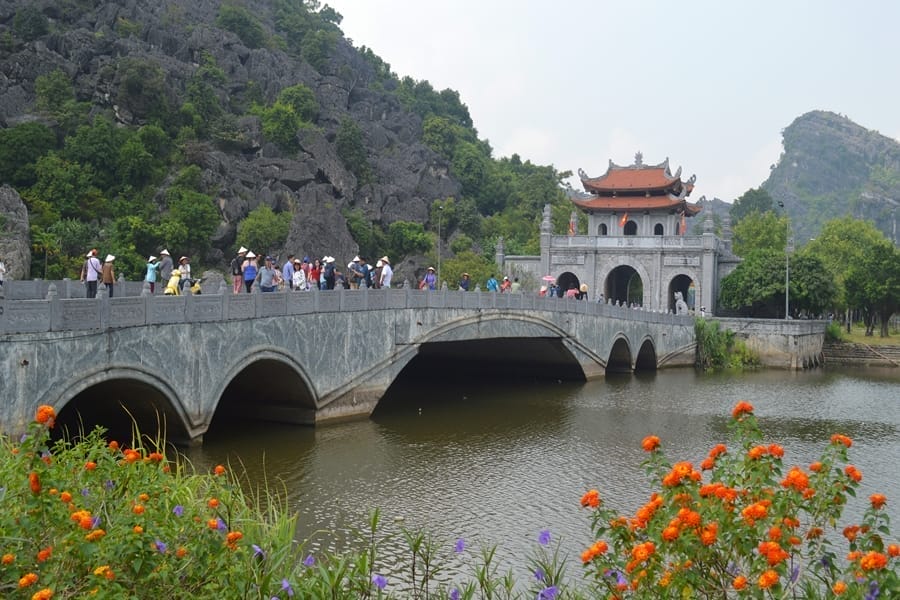
At the central Ninh Binh’s outskirt, you will see the western entrance gate of Hoa Lu ancient capital. Crossing the bridge is the three-entrance gate which was perfectly restored. Behind the gate is the significant things waiting for your visit.
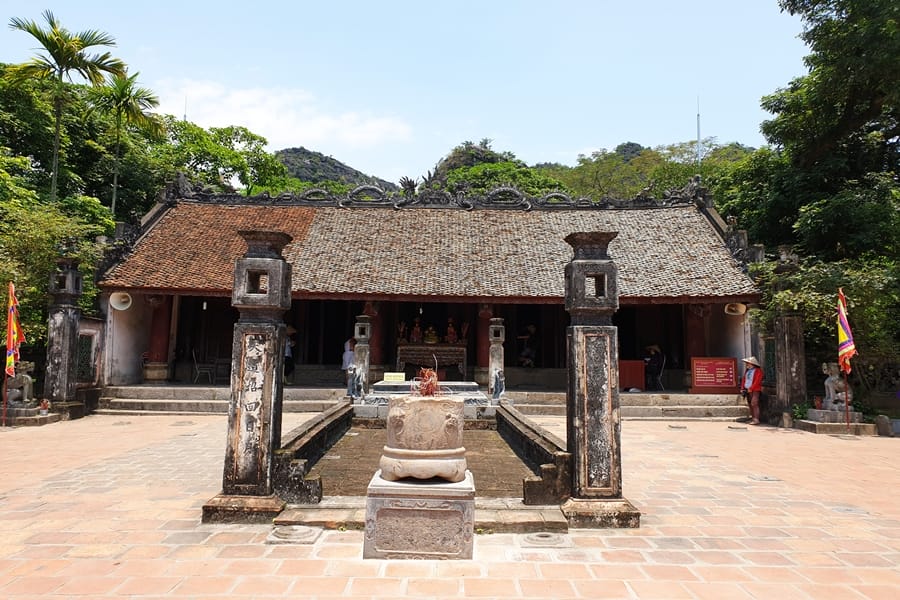
Temples of king Dinh Tien Hoang and king Le Dai Hanh
The temples are located at the center of citadel facing to Ma Yen mountain. The temples are dedicated the kings, queen mother and their princesses making them the most unique one in Vietnam. The temple of king Dinh is located on the left and the king Le’s is on the other direction. As soon as, you pass the temple of King Dinh’s gate, you will see the “stone dragon beds” which is the national treasures. At the end of the temple is the place for worshiping king Dinh and his three princesses with the symmetric and solemn design. Located 300m from temple of king Dinh is the temple of king Le’s temple in which the architecture is fairly the same to the king Dinh’s temple. The difference is that Le Dai Hanh’s temple is smaller than the one of Dinh Tien Hoang to express the honor to the king (Le Hoan was the commander-in-chief and the right hand of King Dinh Tien Hoang before taking the throne and open up his dynasty – early Le).
Note: you are kindly advised to were properly for visits to any spiritual places in Vietnam (shoulders and leg should be covered)
Nhat Tru Pagoda
Nhat Tru pagoda was built on 995 locally known as “One-pillar” pagoda. It was the place for gathering of mandarins who later played very important role in consulting the kings. The name was originally taken from its octagonal shape so it is not similar with the famous “one-pillar pagoda” in Hanoi. The pagoda is keeping many antique items associated with the history of Hoa Lu foundation. In particular the most remarkable feature in the pagoda is the stone pillar with Buddhist law carved on which is the national treasure.

Am Tien cave (Tuyet Tinh Coc)
Am Tien cave is located about 400m from Dinh Tien Hoang’s temple. It is also the name of the pagoda in cave. After passing 205 stone steps, the pagoda is shown up in front of you. The most area of Am Tien cave is a watery valley covered by karst mountain. The cave under Dinh dynasty was the place keeping tigers to kill the guilty.
At the last years of life, queen mother – Duong Van Nga became a monk and lived at Am Tien. Until the Ly dynasty, zen master – Nguyen Minh Khong lived in the cave and built Buddha platforms in the cave. Currently, the pagoda is dedicated to buddhas and zen master Nguyen Minh Khong and the celebrities under Dinh dynasty.
Travelers talk about us ...
Found this trip organiser on forums/websites and thank to some very good reviews, my friend and I were looking to discover the Vietnamese's
I was referred by a friend to Mr. Ha Nguyen at Vietnam Original Travel - Hanoi Branch and I’m so very very pleased that I was
We pre-booked a short trip around Northern Vietnam with Vietnam Original tours. They responded very quickly to email and were very helpful
And we are recommended