

 France
 Espagnol
Áo dài, a Vietnamese traditional dress
ÁO DÀI which is a Vietnamese traditional dress, or most well-known under the name áo dài, has always been one of the most iconic things when it comes to what could be representing Vietnam best. Consisting of a tight-fitting silk harmoniously accompanied by pants, áo dài has inherently been an elegant symbol of the Vietnamese in general and of the Saigonese in particular. Interestingly, áo dài on linguistic levels just simply means 'long shirt,' familiar, comfortable, and minimalistic.
Regarding the events that led to the birth of áo dài, let's get on a time machine to travel back to the 18th century. Áo dài first appeared in Huế as a Vietnamese traditional dress in this period, as a costume required to be worn at the court of the Nguyễn Lords. The further reason behind comes from Lord Nguyen; he wanted to establish a separate identity from the Trinh lords, his rivals from the North. Thus the áo dài came into life and has remained a stable status, both politically and socially until now.

Áo dài - a Vietnamese traditional dress in the modern life
Parts of this Vietnamese traditional dress:
Tà sau: back flap
Nút bấm thân áo: hooks used as fasteners and holes
Ống tay: sleeve
Đường bên: inside seam
Nút móc kết thúc: main hook and hole
Tà trước: front flap
Khuy cổ: collar button
Cổ áo: collar
Đường may: seam
Kích (eo): waist

Parts of Áo dài - a Vietnamese traditional dress
You can wear áo dài with a nón lá (conical leaf hat), a style associated with Huế. Another headgear called khăn đóng is also worn on weddings and some formal occasions.
Even though many Vietnamese opines that the áo dài is a variation of the áo tứ thân (another Vietnamese traditional dress, translated roughly to 'four-panel tunic,') the two of them were born from different and separate origins. Áo tứ thân is usually worn by women in the North. Consisting of four panels, two in the back and two in front; with the back panels sewn together while the front panels are left open or tied by a belt, áo tứ thân is generally different from áo dài. Inside the áo tứ thân, a type of bodice (known as “Yếm”) is worn to cover the chest, and a long skirt (known as “Váy”) to cover the legs. In short, áo tứ thân is quite of a symbol of aesthetics. However, at that time, áo dài was not.
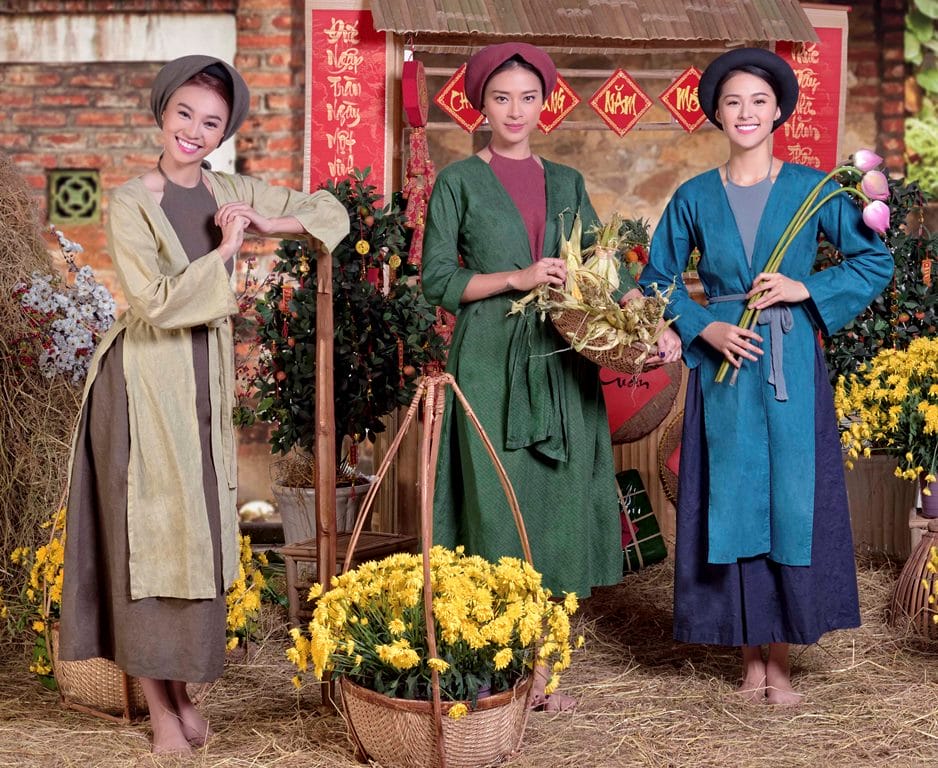
Áo tứ thân - a Vietnamese traditional dress in the colonial times
Back to áo dài, the costume then evolved into the "áo ngũ thân," distinctively different from áo tứ thân with a five-paneled aristocratic gown, and is usually worn in the late 19th and early 20th centuries. A notable turn came to áo dài when Nguyễn Cát Tường, Hanoi University, and some other artists redesigned the áo ngũ thân, turning it into a modern dress worn in the 1920s and 1930s. Áo dài then made it to political stage when Tran Le Xuan, the wife of Ngo Dinh Diem, President of South Vietnam's First Republic, used áo dài to promote her New Woman Movement. After being banned by the government of Vietnam because in their opinion, áo dài was a symbol of "capitalist decadence," áo dài resurrected and regained its status, thanks to Truong Quynh Mai in the late 1980s. She was given the Best National Costume by Miss International Pageant in Tokyo.
Nowadays, the áo dài is obviously the first choice of Vietnamese women when it comes to what to wear on special occasions. Thus the Vietnamese traditional dress has been gradually associating with celebration and consequently labeled as the symbol of the beauty of Vietnamese woman. Furthermore, ao dai is now standard of what a “good” and “traditional” Vietnamese girl should look like. For instance, ao dai is now also the uniform required to be worn at work and at school. Áo dài is omnipresent, and if you are on some Vietnam tours, you will most likely see áo dài everywhere you go. Even foreigners couldn't resist the temptation of áo dài, many of them after having decided to get married in Vietnam and have an immediate Vietnam honeymoon, they instantly pick áo dài for their weddings.

Áo dài - a Vietnamese traditional dress for man
In another story existed the áo dài for men. Unlike the áo dài for women, it did not change much and is rarely worn by the more modern and youngergenerations due to the influence of the masculinity and practicality engendered by Western men's clothing. At times, we still see some men wearing áo dài, and this is understandably nostalgic.
The áo dài basically reflects a painstaking evolution and adaptability of the Vietnamese because it offers cultural and historical values. In this modern age of technology, the reputation of áo dài might be in instability in the future, but at the moment it remains as one of the cultural treasure that the Vietnamese take so much pride in it.
Searched by Google:
- Vietnamese traditional dress
- Vietnam travel agency
- Vietnam tour packages
- Vietnam tours
- Travel Vietnam
Travelers talk about us ...
Found this trip organiser on forums/websites and thank to some very good reviews, my friend and I were looking to discover the Vietnamese's
I was referred by a friend to Mr. Ha Nguyen at Vietnam Original Travel - Hanoi Branch and I’m so very very pleased that I was
We pre-booked a short trip around Northern Vietnam with Vietnam Original tours. They responded very quickly to email and were very helpful
And we are recommended