







 France
 Espagnol
What is the preferred means of transportation for tourists in Vietnam?
What is the preferred means of transportation for tourists in Vietnam?
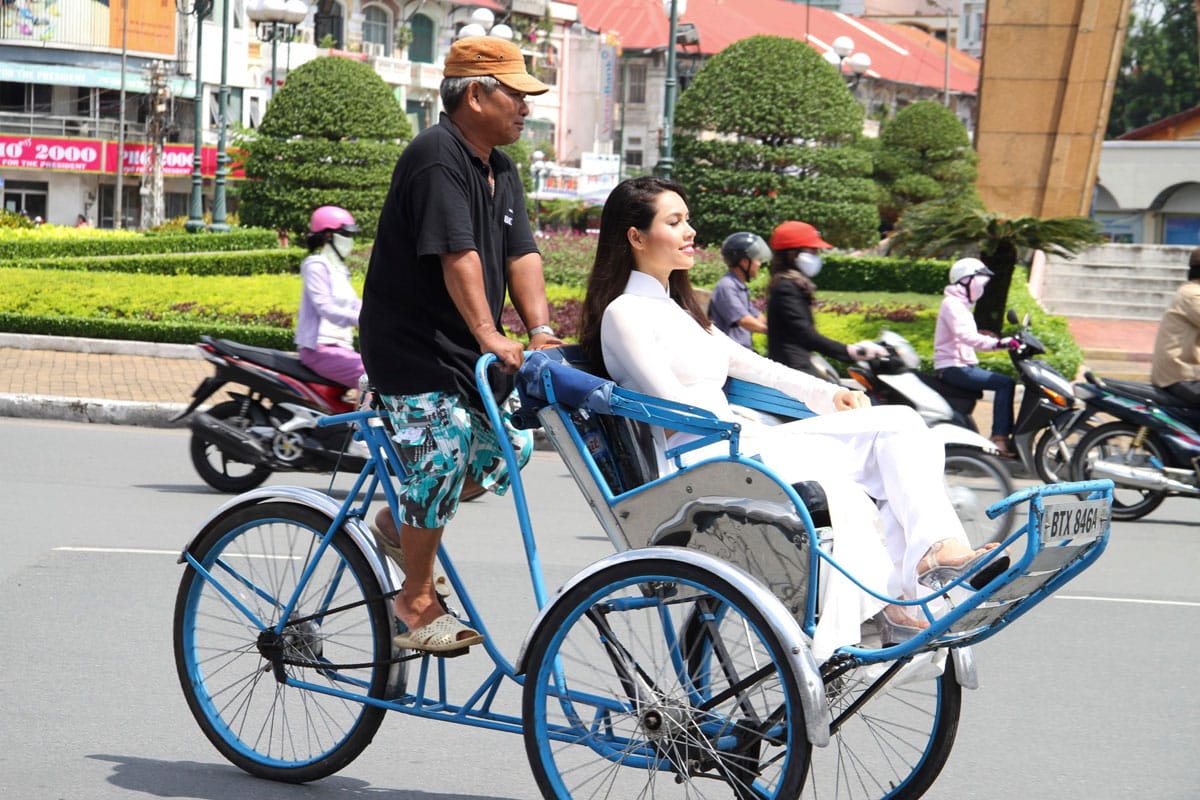
The rickshaw is a three-wheeled bike-taxi that appeared in Vietnam during the French colonial period after an unpopular first introduction under the Nguyen dynasty. It is a double seat (for the Vietnamese, however, because for Westerners, it may be a little fair to two) supported by two wheels before, with the driver sitting behind. The design in Ho Chi Minh City differs from that in Hanoi in that the driver is sitting much higher.
The origins of the pedicab
The rickshaw was born under the Meiji era (1868) in Japan. In Vietnam, the first rickshaws were seen in Hanoi in 1883 as a means of transporting officials to circulate in the city. After that, they gradually grew to become a popular vehicle in Hanoi and some major cities of Vietnam. The rickshaw appeared in Hanoi a year after the birth of the first car in Europe and a year before the tram ride.
At the beginning of the 20th century, bicycles imported from Saint-Etienne (France) appeared for the first time in Hanoi. It is a simple means of transportation that does not require the help of a third person or a horse. Bicycles later became a popular means of transportation in Viet Nam.
In 1936, the first pedicab made its appearance in Vietnam. Sitting in this vehicle, passengers can feel safe, at ease and avoid rainy or sunny weather thanks to the hood.
Nowadays, modern means of transport such as cars and motorcycles replace bicycles. However, bicycles and pedicabs can still be seen. The rickshaws are renovated and decorated to attract tourists and have become one of the cultural charms of Vietnam.
Cyclops nowadays
In large cities, their use as a means of passenger transport has virtually disappeared in recent years. Taxi fares have come down and buses have significantly reduced the market price.
Nevertheless, they remain as a popular tourist attraction, but are generally not used in Vietnam for city tours, as they are prohibited on many major roads where the speed limit is likely to endanger traffic.
They are often used to transport bulky items to reduce delivery costs, but their low speed can sometimes be inconvenient for other road users. For tourists, it's a good idea to have a camera on hand to take a picture of these unlikely transporters of bedroom furniture, live pigs, scaffolding poles ...
If you want to rent a rickshaw, you have to negotiate the fare in advance. If you do not, the driver will often charge you an exorbitant price, then make you sing by making a scandal in Vietnamese to attract the crowd that will naturally defend the driver. Both means of transportation are very famous in Vietnam and you will surely have a chance to experience it during your holidays in Vietnam.
Travelers talk about us ...
Found this trip organiser on forums/websites and thank to some very good reviews, my friend and I were looking to discover the Vietnamese's
I was referred by a friend to Mr. Ha Nguyen at Vietnam Original Travel - Hanoi Branch and I’m so very very pleased that I was
We pre-booked a short trip around Northern Vietnam with Vietnam Original tours. They responded very quickly to email and were very helpful
And we are recommended